Virtual Terminal Capabilities
A complete solution for businesses that accept payments over the phone, by mail, or through invoicing.
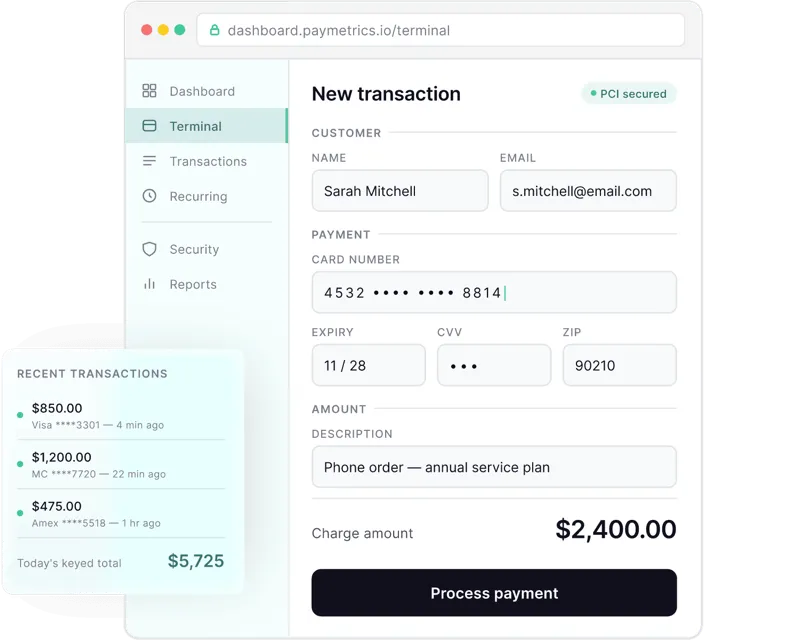
Browser-Based Processing
No software to install or hardware to maintain. Log in to your secure virtual terminal from any web browser and start keying in payments immediately.
Recurring Billing
Set up automatic payments for repeat customers with scheduled billing. Manage subscription plans, installment payments, and membership dues from one interface.
PCI Compliant
Secure tokenization and encryption protect stored card data for recurring transactions. Our virtual terminal meets the highest PCI compliance standards.
What Is a Virtual Terminal and How Does It Work
A virtual terminal is a secure, browser-based application that allows merchants to process credit and debit card payments directly from any internet-connected computer. Unlike a traditional point-of-sale terminal that requires dedicated hardware, a virtual terminal runs entirely in your web browser. You log in to a secure online payment portal, enter the customer's card details, and submit the transaction. The payment is authorized and settled through your merchant account just like any other card transaction.
This makes the virtual terminal one of the most flexible payment tools available to businesses today. There is no equipment to lease, no software to install, and no maintenance to worry about. Whether you are at a front desk, a home office, or a call center, you can process payments from any device with a browser. For businesses that do not operate a physical storefront or that handle a significant volume of phone payments, the virtual terminal replaces expensive hardware with a streamlined digital workflow.
MOTO Payments and Keyed-In Transactions
MOTO payments — short for mail order and telephone order — are one of the most common use cases for a virtual terminal. When a customer calls to place an order or mails in a payment form, the merchant manually enters the card number, expiration date, CVV, and billing address into the virtual terminal. This is known as a keyed transaction, and it is the standard method for processing card-not-present sales in environments where the physical card is not available.
Keyed-in transactions through a virtual terminal give businesses the ability to serve customers who prefer to order by phone rather than online. This is especially important for service-based industries, B2B suppliers, medical offices, and nonprofits that frequently accept phone payments or pledges. The virtual terminal captures all necessary transaction data in one interface, and each keyed transaction is routed through the same secure processing network used by in-person card readers.
Because MOTO payments are classified as card-not-present transactions, they are subject to slightly different interchange rates than card-present swipes or dips. A well-configured virtual terminal helps you capture the right data fields — such as AVS and CVV — to qualify for the best possible rates on every keyed transaction.
"We switched from writing down card numbers on paper to using the virtual terminal, and it changed everything. Payments are faster, safer, and we never lose a transaction."
— Operations Manager, Regional Services Company
Recurring Payments and Subscription Billing
Many businesses rely on predictable, recurring revenue — monthly memberships, quarterly service contracts, weekly deliveries, or annual subscriptions. A virtual terminal with recurring billing capabilities allows you to store a customer's payment information securely and charge their card on a set schedule without re-entering the details each time. This eliminates the manual effort of processing repeat payments and reduces the risk of missed or late collections.
Setting up a recurring payment through the virtual terminal is straightforward. You enter the customer's card information once, define the billing frequency and amount, and the system handles the rest. Payment confirmations and receipts can be sent automatically, giving both you and your customer a clear record of each charge. If a payment fails — due to an expired card, for example — the system can notify you immediately so you can follow up before the account falls behind.
For businesses that manage dozens or hundreds of recurring accounts, this capability is essential. It turns the virtual terminal into more than a one-off payment tool; it becomes a central hub for managing ongoing customer billing relationships.
Invoicing and Payment Collection From Your Terminal
A virtual terminal can also serve as the backbone of your invoicing workflow. Rather than sending a paper invoice and waiting weeks for a check, you can generate an invoice through the terminal and email it directly to your customer with an embedded payment link. The customer clicks the link, enters their card details on a secure hosted page, and the payment is processed instantly. This dramatically shortens your accounts receivable cycle.
For situations where the customer prefers to pay over the phone, the process is even simpler. They call your office, provide their card information, and you key the payment into the virtual terminal while referencing the outstanding invoice. The transaction is recorded against that invoice automatically, keeping your records accurate without manual reconciliation. This combination of invoicing and keyed-in payment processing gives businesses a complete receivables solution without needing separate software systems.
Security for Card-Not-Present Transactions
Card-not-present transactions inherently carry more fraud risk than in-person payments because the merchant cannot physically verify the card or the cardholder's identity. This is why security is the most critical component of any virtual terminal. Our platform includes multiple layers of protection designed specifically for card-not-present environments, including address verification service (AVS), CVV matching, and configurable transaction velocity controls that flag unusual activity before it becomes a problem.
All cardholder data entered through the virtual terminal is encrypted in transit and at rest. When card details are stored for recurring billing, they are replaced with secure tokens — randomized identifiers that have no value if intercepted. This tokenization process means that sensitive card numbers are never stored on your systems or accessible to your staff, significantly reducing your PCI DSS compliance burden.
Our virtual terminal is built to meet the highest PCI compliance standards, and we provide tools and guidance to help your business maintain compliance as well. Regular security updates, audit logging of all transactions, and role-based access controls ensure that only authorized personnel can process payments or view sensitive data. For businesses that handle phone payments or store card information for repeat customers, these protections are not optional — they are fundamental to operating responsibly.
"PCI compliance used to keep me up at night. With the tokenization and encryption built into the virtual terminal, I know our customers' data is protected without our team having to manage it manually."
— Owner, B2B Distribution Firm
Ideal Business Types for a Virtual Terminal
Virtual terminals are particularly well suited for businesses that accept a high volume of card-not-present transactions. This includes call centers and customer service departments that process phone payments throughout the day, professional services firms that bill clients after completing work, medical and dental offices that collect balances over the phone, nonprofits that accept donations by phone or mail, and government agencies that process fees and permits remotely.
B2B companies are among the heaviest users of virtual terminals because their customers often place orders by phone, email, or purchase order rather than through an online checkout. The virtual terminal gives these businesses a fast, reliable way to convert those orders into processed payments without requiring the buyer to visit a website. Similarly, field service businesses — such as HVAC, plumbing, and landscaping companies — often take payment details over the phone from customers who are not present at the time of service.
Any business that needs a simple, no-hardware way to accept credit card payments can benefit from a virtual terminal. If your staff regularly keys in card numbers, processes phone payments, or manages recurring billing, the virtual terminal consolidates all of those functions into a single secure online payment portal that works from any browser on any computer.

Trusted Payment Partners


Frequently Asked Questions
Explore More Solutions
Paymetrics provides complete payment solutions for your business, from processing to reporting to support, all from one provider.
Get Started in Minutes
Getting started with Paymetrics is quick and straightforward. Most merchants are approved within 24 hours.
Apply Online
Complete our simple application in minutes. No complex paperwork required.
Get Approved
Most merchants are approved within 24 hours with fast, transparent underwriting.
Start Processing
Begin accepting payments immediately with our easy setup and dedicated support team.