How to Accept Credit Card Payments Without a Merchant Account: 4 Options We Compare for Sellers
Compare four ways to accept credit cards without your own merchant account, including tradeoffs in speed, cost, and control.
Target keyword: how to accept credit card payments without a merchant account (210/mo)
You can accept credit card payments without your own merchant account by using a payment aggregator, a payment link service, an invoicing platform, or a marketplace that processes on your behalf. All 4 work by pooling you under the provider's master merchant account, trading control for instant access.
What Are the 4 No-Merchant-Account Options?
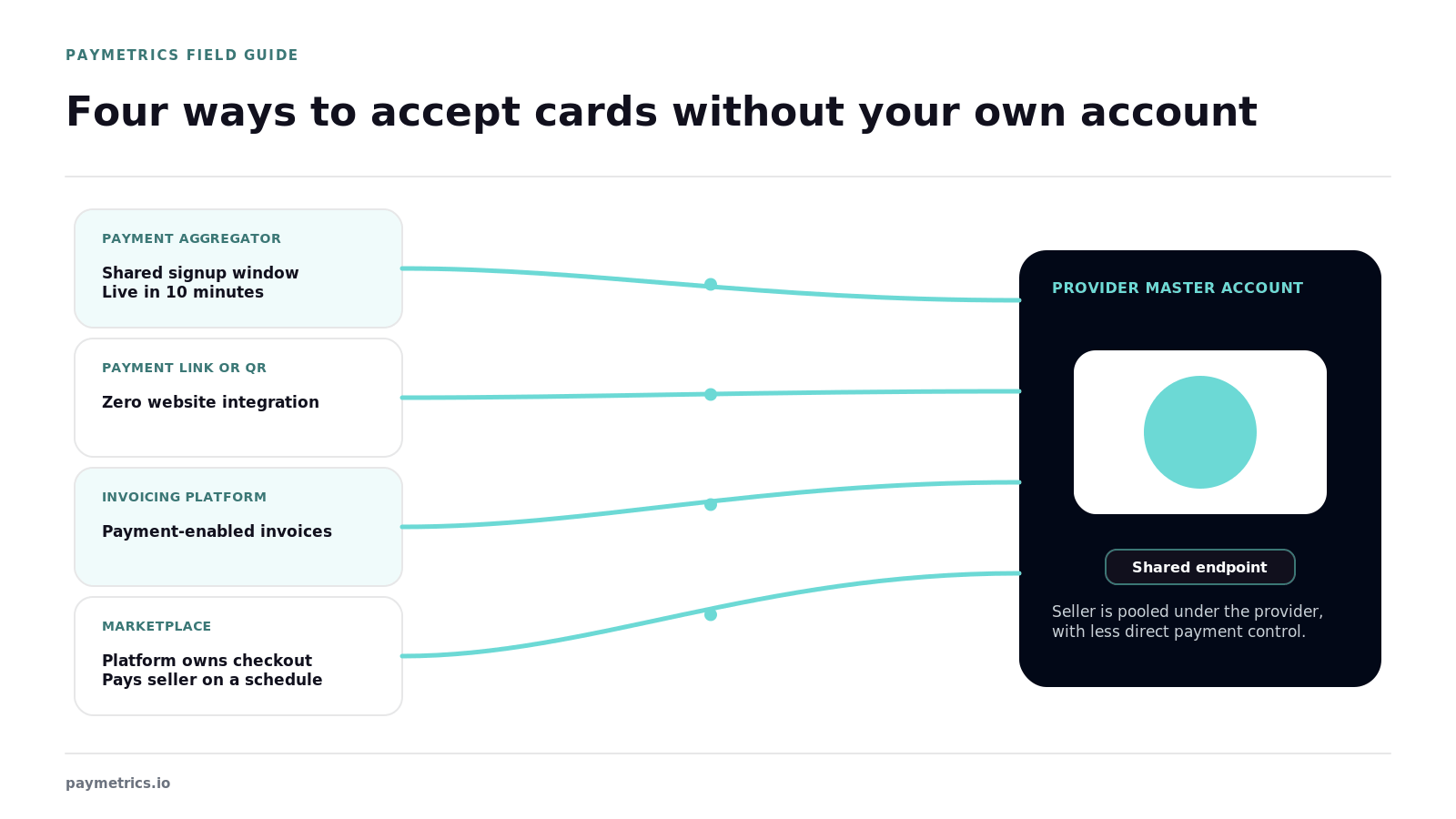
Four acceptance models skip dedicated underwriting entirely:
- Payment aggregators: instant signup under a shared master account, live in 10 minutes
- Payment links and QR codes: card acceptance with zero website integration
- Invoicing platforms: payment-enabled invoices where the platform handles processing
- Marketplaces: the platform owns checkout and pays out your share on a schedule
Each model gets you selling today. The trade-offs show up at scale, not at signup.
What Does Aggregation Really Cost?
Aggregation costs 2.6% to 3.5% flat with no negotiation, roughly 0.3% to 0.8% above dedicated-account pricing at volume. On $25,000 a month, that spread is $900 to $2,400 a year, and flat pricing is a core theme in our best credit card processing for small business comparison.
What Is the Real Risk of Shared Accounts?
The real risk is frozen funds without warning, because you have no underwriting relationship protecting you. Aggregators manage risk by algorithm: a volume spike, a large ticket, or 2 disputes in a week can trigger a 90-day hold on your entire balance with no human to call.
We meet merchants after this exact event every month. It is the accountability gap we describe in payment processors sell infrastructure, not accountability, and it hits hardest at the worst time, mid-growth.
When Should You Graduate to a Merchant Account?
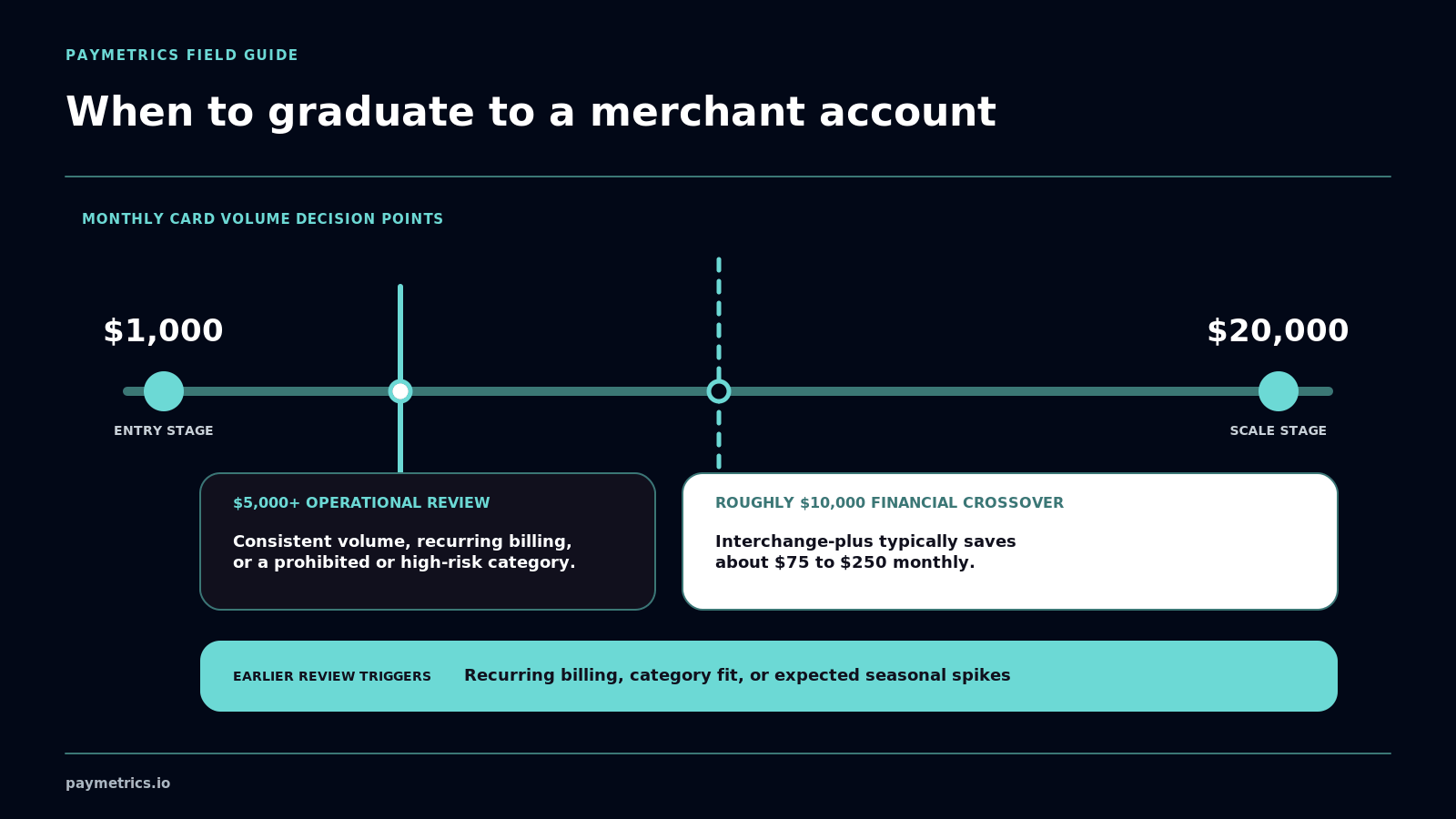
Graduate to a dedicated merchant account when you pass $5,000 in consistent monthly volume, need recurring billing, or sell in a category aggregators prohibit. Regulated and high-risk industries should skip aggregation entirely, since account termination is a matter of when, not if.
At that point the full stack comes into play: a POS system for counters, a payment gateway for ecommerce, and a virtual terminal for phone orders.
How Do the 4 Options Compare on Speed, Cost, and Risk?
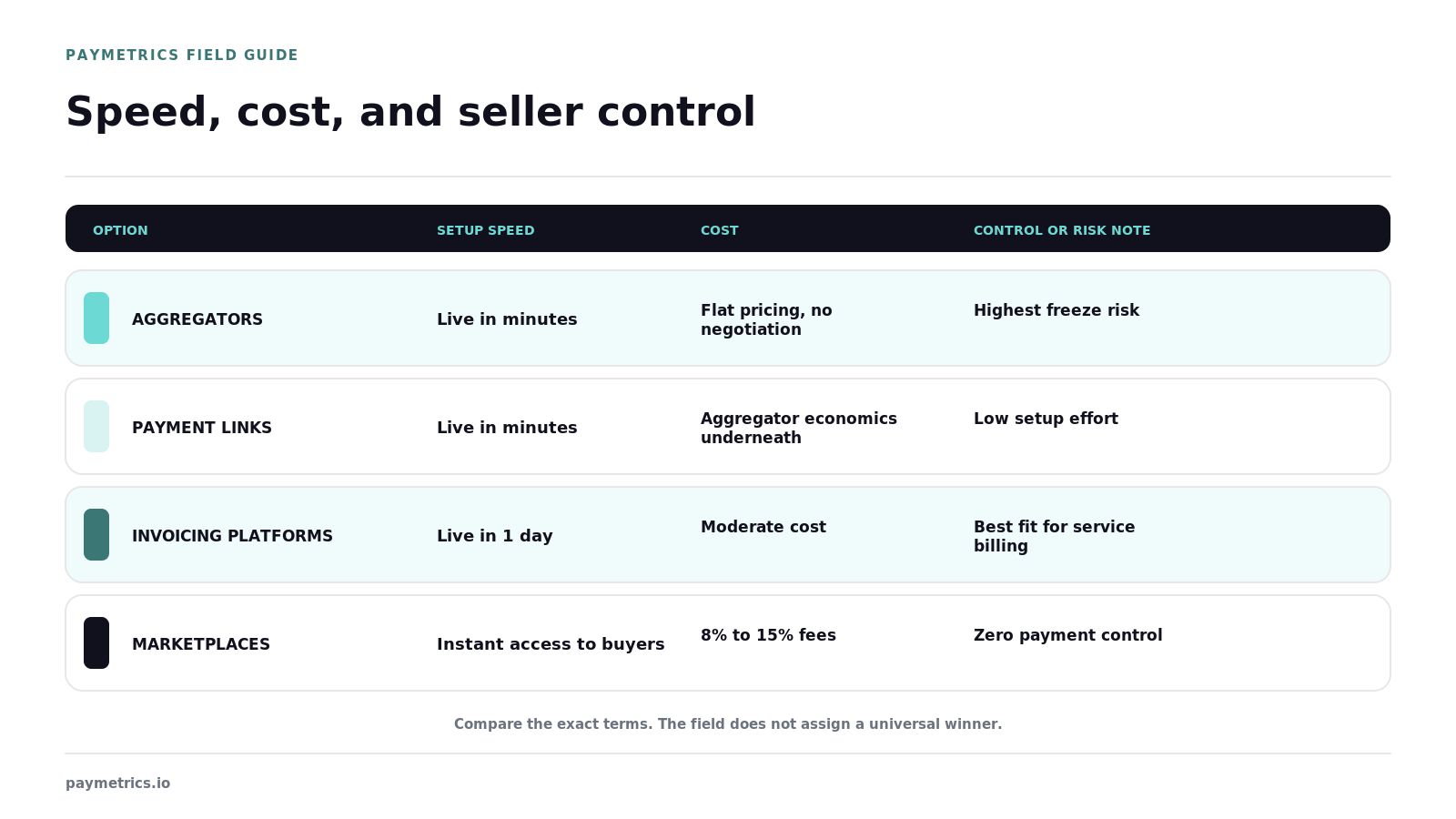
The 4 options trade off predictably across 3 dimensions:
- Aggregators: live in minutes, highest freeze risk, flat pricing with no negotiation
- Payment links: live in minutes, low setup effort, same aggregator economics underneath
- Invoicing platforms: live in 1 day, moderate cost, best fit for service billing
- Marketplaces: instant access to buyers, highest fees at 8% to 15%, zero payment control
Match the option to your stage, not your convenience. The right answer at $1,000 a month becomes the wrong answer at $20,000.
What Should You Track While Using an Aggregator?
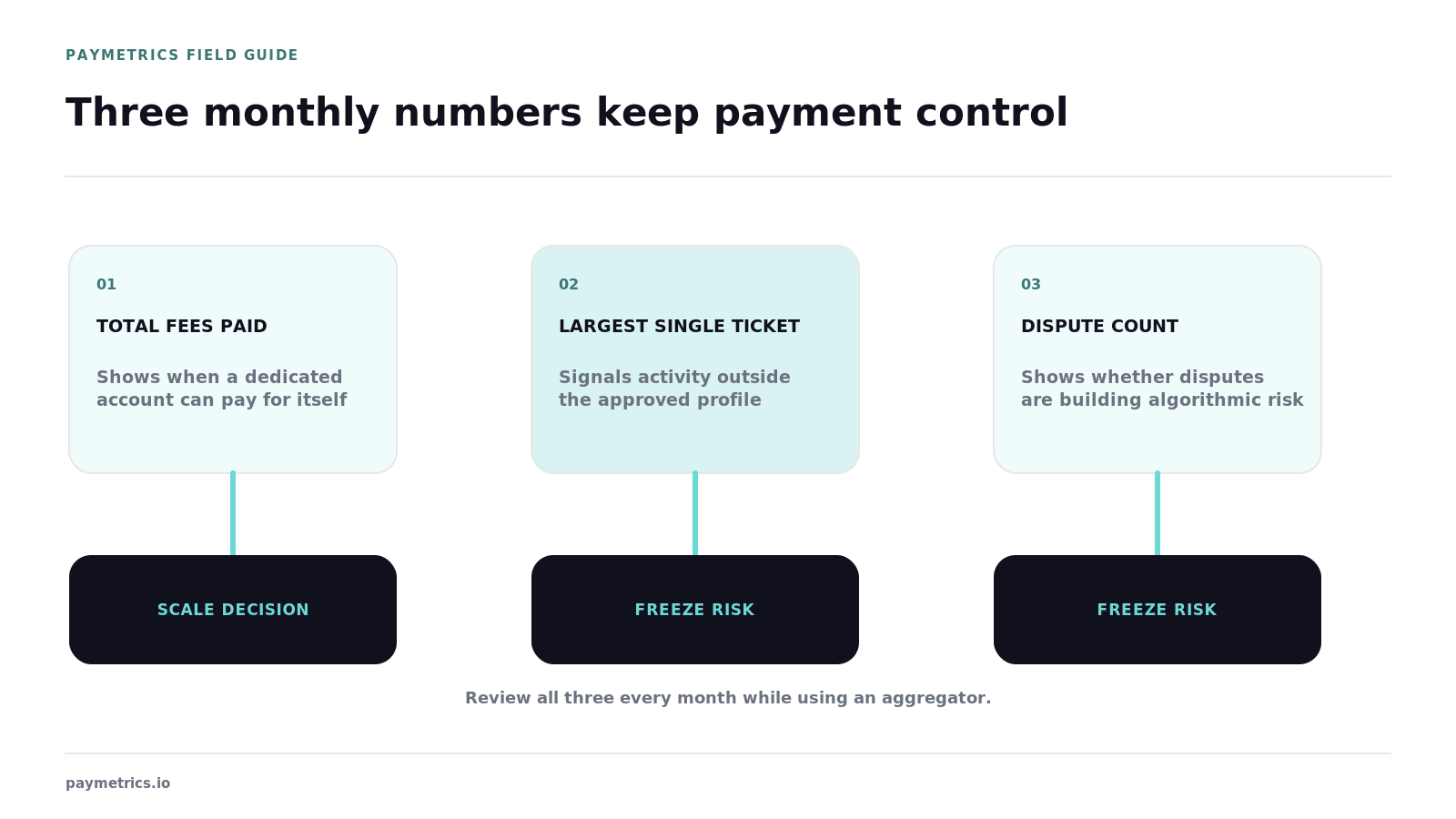
Track 3 numbers monthly while on an aggregator: total fees paid, largest single ticket, and dispute count. The fee total tells you when a dedicated account pays for itself, and the other 2 predict your freeze risk before the algorithm acts on it.
When Does Graduating to a Merchant Account Make Sense?
Graduating makes financial sense at roughly $10,000 in monthly card volume, where interchange-plus pricing typically saves $75 to $250 monthly against flat aggregator rates. Stability is the second reason and often the stronger one.
Businesses expecting seasonal spikes should move earlier. Aggregator freeze algorithms react to sudden volume growth, and a dedicated merchant account with disclosed projections does not.
What Happens If an Aggregator Freezes Your Funds?
A freeze holds your balance while the platform reviews the account, typically 3 to 30 days, and communication during that window is limited by design. Respond to every documentation request within 24 hours and keep a secondary payment method available. Businesses with a backup acceptance option survive freezes as an inconvenience rather than a crisis.
Related Questions From New Sellers
Are Payment Links Safe for Phone Orders?
Payment links beat reading card numbers over the phone, and for regular phone volume, our MOTO payments guide explains the compliant setup.
Do Aggregators Report Processing History?
Mostly no, which means years on an aggregator build little underwriting history. Merchants planning to scale start the dedicated-account clock sooner rather than later.
Table of Contents
Subscribe to our newsletter
Get the latest insights and updates delivered to your inbox.

What Is a Merchant Account? What We Walk Every New Business Owner Through First
Learn how a merchant account moves card funds, how it differs from a bank account, and which fees and controls to review.
How to Set Up a Merchant Account: The 5-Step Process We Guide Merchants Through
Follow the five-step merchant account setup process, from choosing a provider and applying through approval, integration, and monitoring.

How to Get a Merchant Account With Bad Credit: What We Have Actually Seen Work
Learn what underwriters evaluate when credit is weak and which documentation, reserves, and account history can improve approval odds.