How to Get a Merchant Account With Bad Credit: What We Have Actually Seen Work
Learn what underwriters evaluate when credit is weak and which documentation, reserves, and account history can improve approval odds.

You can get a merchant account with bad credit by applying through high-risk-friendly providers, offering a rolling reserve, and documenting strong business revenue. Personal credit is only 1 of 5 underwriting factors, and we have seen merchants with sub-550 scores approved in under a week.
How Much Does Personal Credit Actually Matter?
Personal credit matters less than business fundamentals in most underwriting decisions. Acquiring banks weigh 5 factors together:
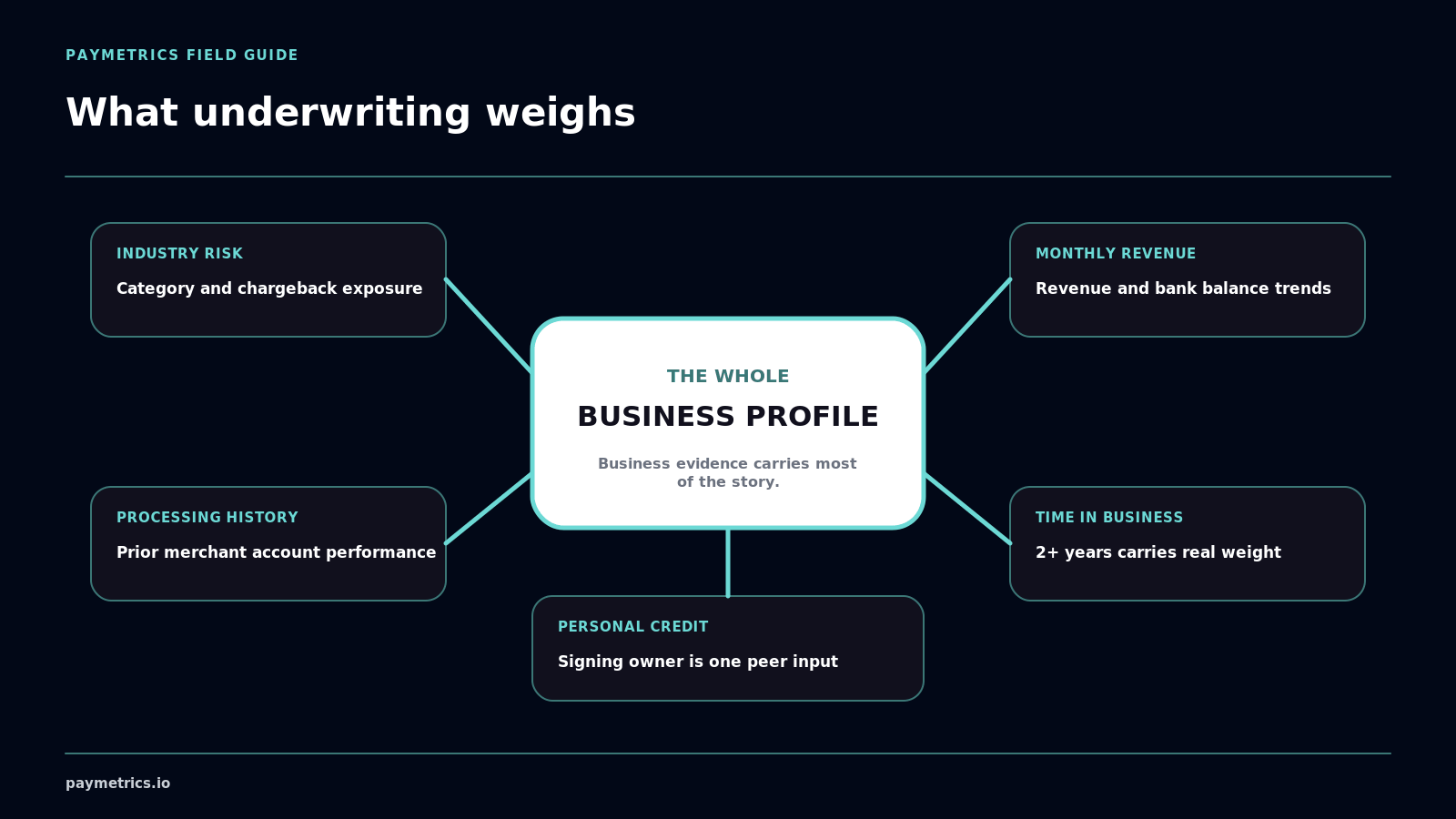
- Industry risk category and chargeback exposure
- Processing history from prior merchant accounts
- Monthly revenue and bank balance trends
- Time in business, with 2+ years carrying real weight
- Personal credit of the signing owner
Strong revenue with weak credit approves far more often than the reverse. Banks fund transactions, not credit scores.
What 4 Concessions Get Bad-Credit Applications Approved?
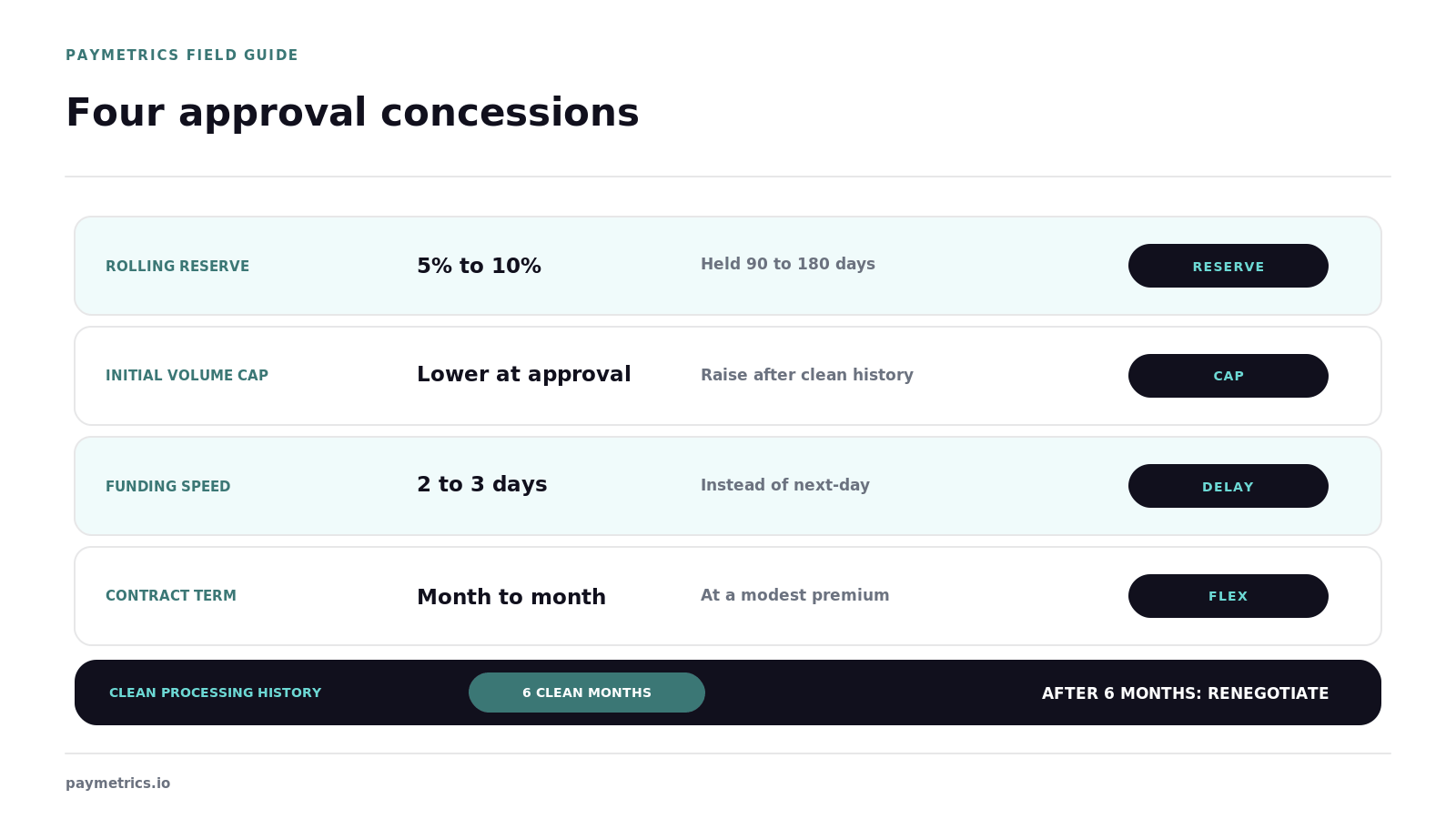
Four concessions turn denials into approvals: a rolling reserve of 5% to 10% held for 90 to 180 days, a lower initial volume cap, delayed funding of 2 to 3 days instead of next-day, and month-to-month pricing at a modest premium. Each one reduces the bank's exposure while you build history.
After 6 months of clean processing, we renegotiate. Reserves release, caps lift, and pricing normalizes, because performance history replaces the credit question.
Which Providers Should Bad-Credit Merchants Target?
Target providers with in-house high-risk underwriting rather than big-bank resellers that auto-decline on credit pulls. Our high-risk merchant services practice exists for exactly this profile, and industries like automotive repair and healthcare with owner credit damage are routine approvals, not exceptions.
What Should You Avoid While Rebuilding?
Avoid 3 traps while rebuilding: aggregator-only setups that freeze funds without warning, 3-year contracts with termination fees, and letting disputes pile up. Approval is fragile in year 1, and since chargebacks and declines are operational problems, a 1% dispute ratio can undo everything the concessions bought you.
What Does the Rebuilding Timeline Look Like Month by Month?
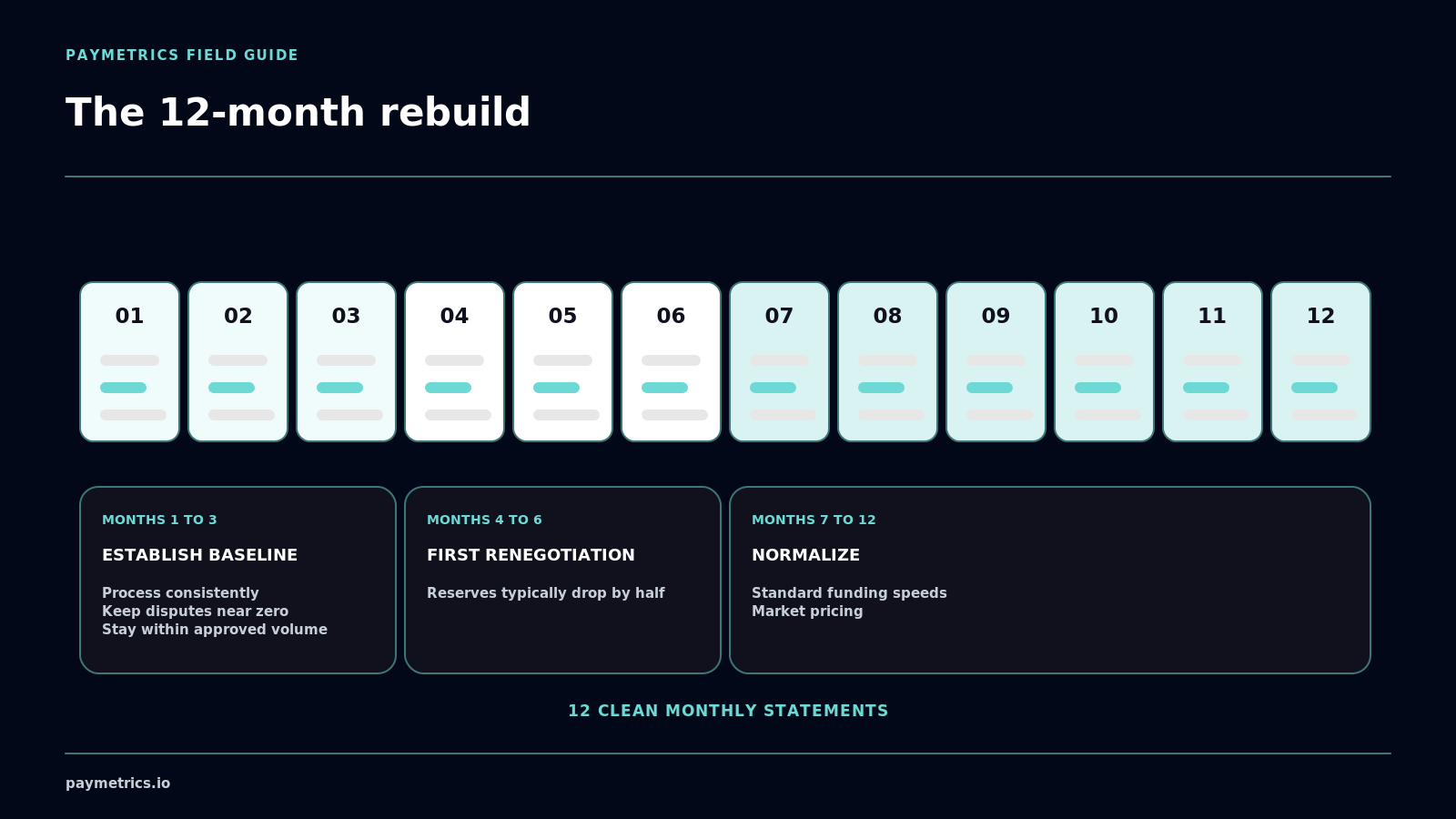
The rebuilding timeline runs in 3 predictable phases. Months 1 to 3 establish baseline: process consistently, keep disputes near zero, and never exceed approved volume without a heads-up call. Months 4 to 6 open the first renegotiation window, where reserves typically drop by half. Months 7 to 12 normalize the account, with most merchants reaching standard funding speeds and market pricing.
Document everything along the way. A folder of 12 clean monthly statements is the strongest credit repair instrument a merchant owns, stronger than the personal score itself.
What Warning Signs Suggest a Provider Is Exploiting Your Situation?
Three warning signs separate fair high-risk pricing from exploitation: rates above 5% for a conventional business, reserves above 15% with no release schedule in writing, and termination fees over $500. Bad credit justifies caution, not captivity, and any provider refusing to put the reserve release schedule in the contract has told you the plan.
Does Applying Hurt Your Credit Score?
Most merchant account applications involve a soft credit inquiry that does not affect your score, though some providers run a hard pull for accounts with large projected volume or equipment financing. Ask which type before submitting.
Shopping several providers is still worth doing. Soft pulls carry no cumulative penalty, and comparing 3 offers is how merchants with damaged credit find the reasonable one.
Does the Business or the Owner Get Evaluated?
Underwriters evaluate both, weighing business financials and processing history alongside personal credit for owners above 25% ownership. Strong business fundamentals can offset a weak personal score, which is why documented revenue and clean prior statements deserve as much preparation attention as the credit report itself. Owners with damaged credit should lead with business performance in the application narrative rather than waiting for underwriting to discover it on its own.
Related Questions From Credit-Challenged Applicants
Does Accepting Cards Help Rebuild the Business?
Yes, consistent card volume through a POS system or payment gateway builds the processing history that outweighs credit on every future application.
Can You Reduce Costs During the Reserve Period?
Yes, dual pricing programs offset processing costs during the reserve period, and clean recurring billing revenue is underwriting gold at renegotiation time.
Table of Contents
Subscribe to our newsletter
Get the latest insights and updates delivered to your inbox.

What Is a Merchant Account? What We Walk Every New Business Owner Through First
Learn how a merchant account moves card funds, how it differs from a bank account, and which fees and controls to review.

How to Set Up a Merchant Account: The 5-Step Process We Guide Merchants Through
Follow the five-step merchant account setup process, from choosing a provider and applying through approval, integration, and monitoring.

How to Accept Credit Card Payments Without a Merchant Account: 4 Options We Compare for Sellers
Compare four ways to accept credit cards without your own merchant account, including tradeoffs in speed, cost, and control.