What Is Recurring Billing? Which Business Models It Fits, From the Team That Runs It
Learn how recurring billing works, which business models benefit, and how payment controls can reduce churn and revenue leakage.

Recurring billing is a payment arrangement that automatically charges a customer's stored card or bank account on a fixed schedule, like monthly or annually, until the customer cancels. It is the billing engine behind subscriptions, memberships, and retainers, and it turns collections from a chase into a schedule.
What Happens on Each Billing Cycle?
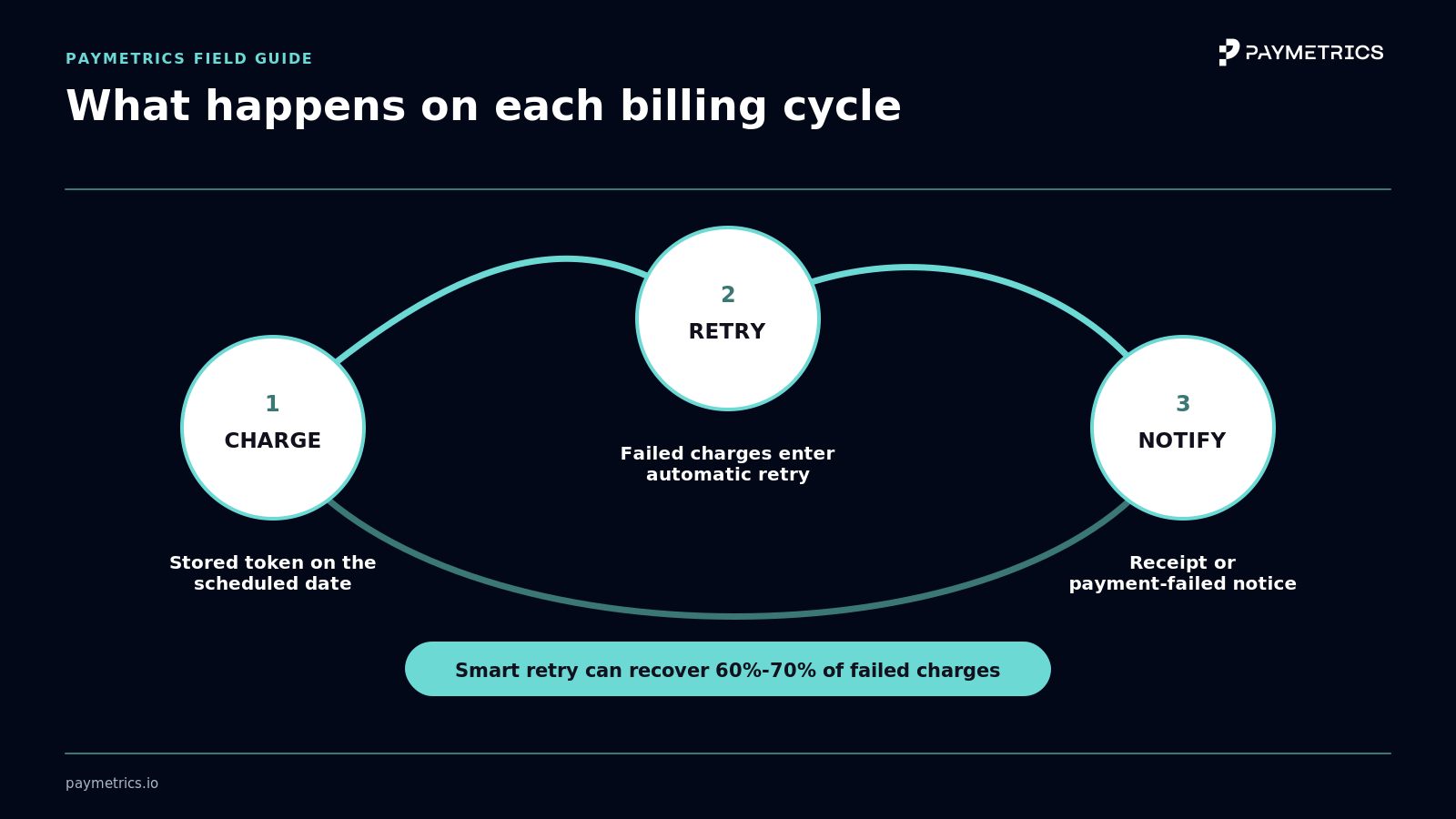
Once configured, each cycle runs without human involvement across 3 stages: the platform charges the stored token on the scheduled date, failed charges enter automatic retry, and the customer receives a receipt or a payment-failed notice. Our walkthrough on how to set up automatic payments covers the configuration steps themselves.
The retry stage is where platforms earn their keep. Smart retry timing recovers 60% to 70% of failed charges without a single manual email.
Which 4 Business Models Should Be Using It?
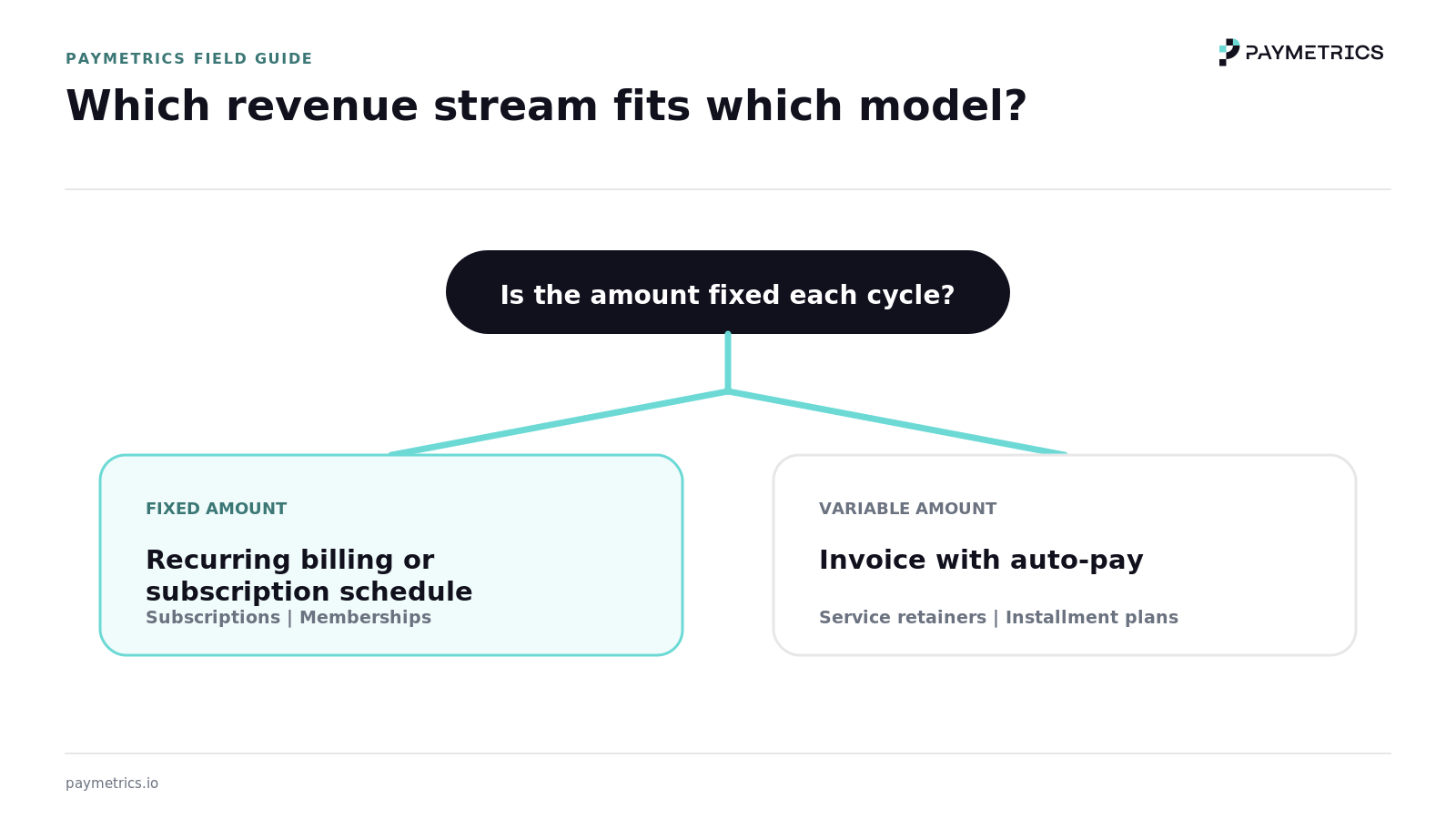
Four models benefit most from recurring billing: subscription products, memberships like gyms and clubs, service retainers at agencies and firms, and installment plans on large tickets. The professional services firms and healthcare practices we set up typically cut days-sales-outstanding by 2 to 3 weeks in the first quarter.
Nonprofits are the sleeper category. Monthly giving programs convert 1-time donors into 12-charge donors with 1 checkout change.
What Keeps Recurring Revenue From Leaking?
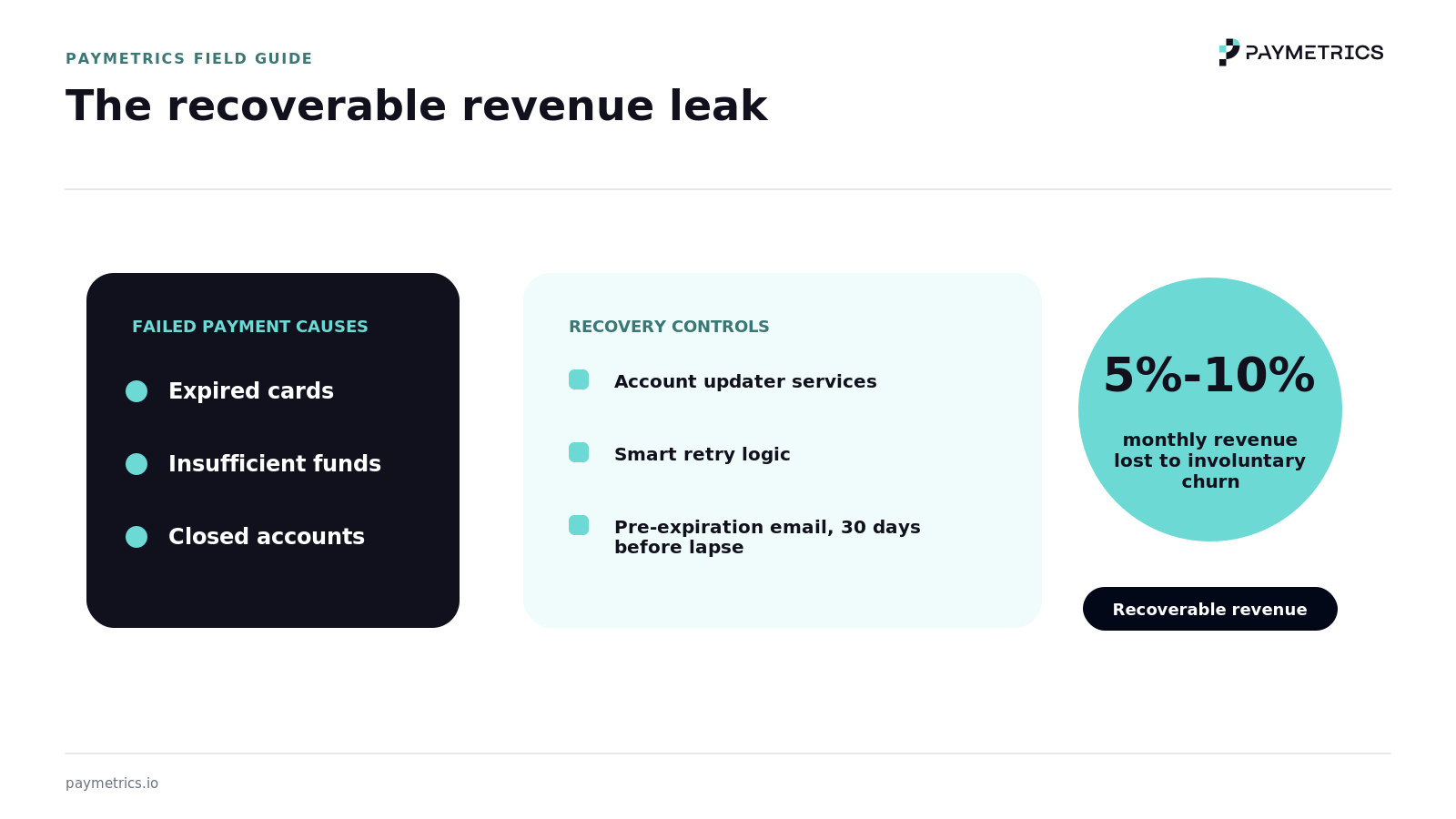
Three tools prevent revenue leakage: automatic card updaters that refresh expired card numbers, decline-aware retry logic, and clean billing descriptors that stop why-was-I-charged disputes. Involuntary churn from failed payments runs 5% to 10% monthly on unmanaged setups, and since chargebacks and declines are operational problems, configuration beats hope.
How Does Recurring Billing Differ From Auto-Pay Invoicing?
Recurring billing charges a fixed plan automatically, while invoicing with auto-pay charges whatever each invoice totals. Variable monthly amounts belong on auto-paid invoices; fixed plans belong on subscription schedules. Our walkthrough on how to set up automatic payments for business maps which model fits which revenue stream.
What Should a Customer-Facing Billing Policy Include?
A recurring billing policy needs 5 elements customers can find in 30 seconds:
- The exact amount and date charged each cycle
- How to cancel, in 1 step, without calling a retention line
- The refund rule for the current cycle after cancellation
- The card descriptor name that will appear on statements
- Advance notice terms for any price change
Clear policies are dispute prevention. The majority of subscription chargebacks we see cite confusion, not fraud, and every element above removes a confusion.
Which 3 Metrics Tell You Recurring Billing Is Working?
Track 3 numbers monthly once recurring billing is live: monthly recurring revenue, involuntary churn from failed charges, and average subscriber lifespan. The middle number is the one owners overlook, and it is usually the largest recoverable leak in a subscription business.
How Do You Reduce Failed Recurring Payments?
Failed rebills come from expired cards, insufficient funds, and closed accounts, and 3 tools recover most of them:
- Account updater services that refresh card credentials automatically
- Smart retry logic that reattempts on likely-funded days rather than immediately
- Pre-expiration email prompts sent 30 days before a card lapses
Subscription businesses typically lose 5% to 10% of monthly revenue to involuntary churn. Recovering even half of that beats most acquisition campaigns on cost per dollar.
What Does Recurring Billing Cost to Operate?
Recurring billing typically adds $10 to $30 monthly in platform fees plus standard processing on each charge. Compare that against the labor of manual invoicing and collections, which for a 200-subscriber base runs several hours per cycle. The automation pays for itself well below that subscriber count.
Related Recurring Revenue Questions
Where Do the Charges Actually Run?
Recurring charges run through your payment gateway against stored tokens, the same rails as your ecommerce checkout.
Does Stored-Credential Volume Get Better Rates?
Yes, properly flagged stored-credential transactions qualify for favorable interchange categories, a detail our best credit card processing for small business guide covers.
Table of Contents
Subscribe to our newsletter
Get the latest insights and updates delivered to your inbox.
How to Read a Merchant Statement: A Line-by-Line Analysis
Review a merchant statement line by line, calculate the effective rate, identify padded fees, and turn the findings into savings.
What Is a Payment Facilitator (PayFac)?
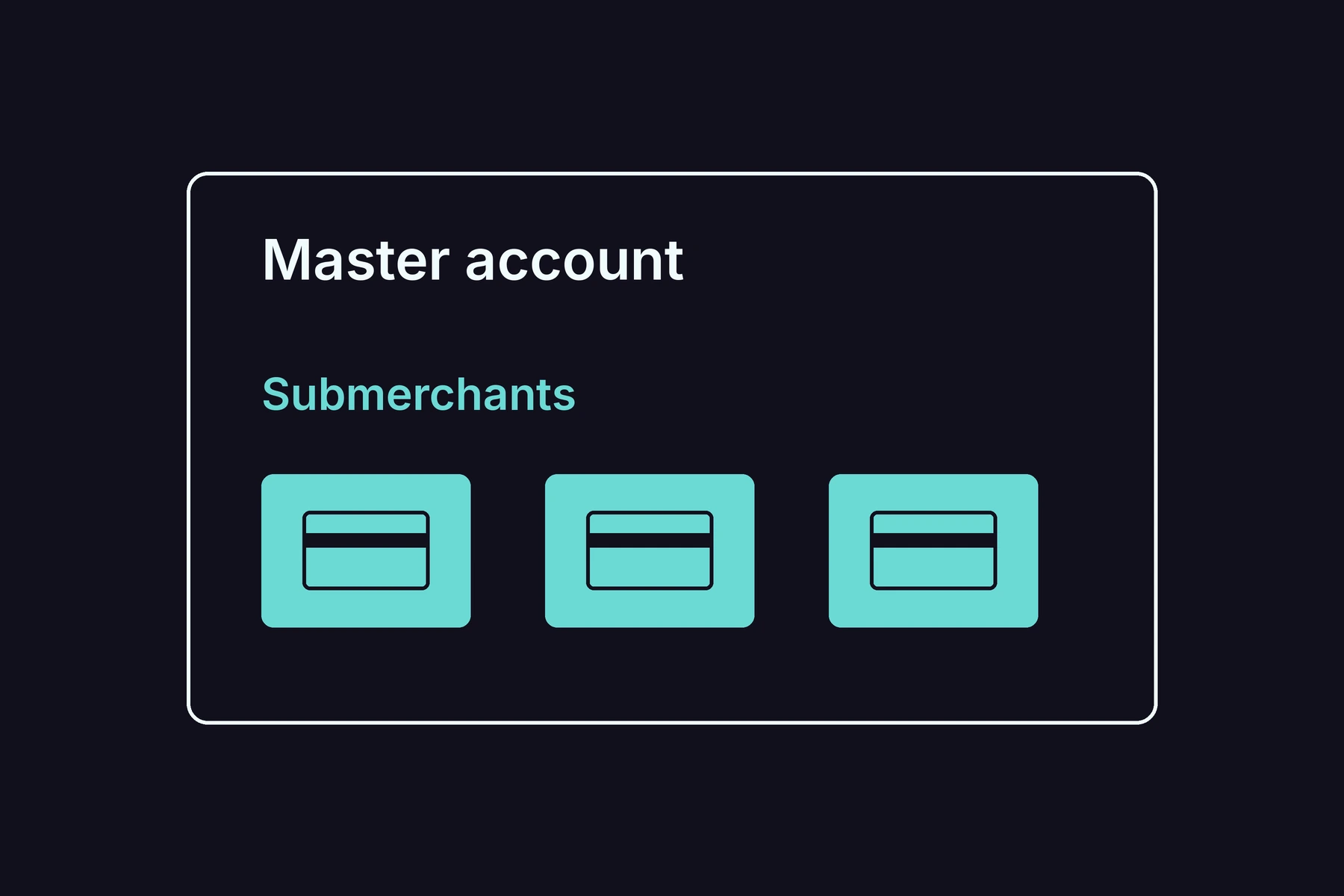
A payment facilitator, commonly shortened to PayFac, is a company that holds a master merchant account and onboards other businesses as submerchants underneath it.
How to Calculate Credit Card Processing Fees: The 3-Step Method We Use on Every Statement Audit
Calculate your effective processing rate in three steps, compare healthy ranges, and find hidden costs on merchant statements.