How to Read a Merchant Statement: A Line-by-Line Analysis
Review a merchant statement line by line, calculate the effective rate, identify padded fees, and turn the findings into savings.

A merchant statement analysis is a line-by-line review of your processing statement that separates non-negotiable network costs from processor markup. Most merchants never perform one, which is exactly why padded fees survive for years inside bundled rates.
What Are the 4 Sections of Every Merchant Statement?
Every statement contains 4 sections regardless of which processor produced it.
- Summary: total volume, total transactions, gross deposits, and total fees.
- Interchange detail: transactions grouped by qualification category.
- Assessments: card network charges tied to volume.
- Other fees: monthly, per-transaction, and service line items.
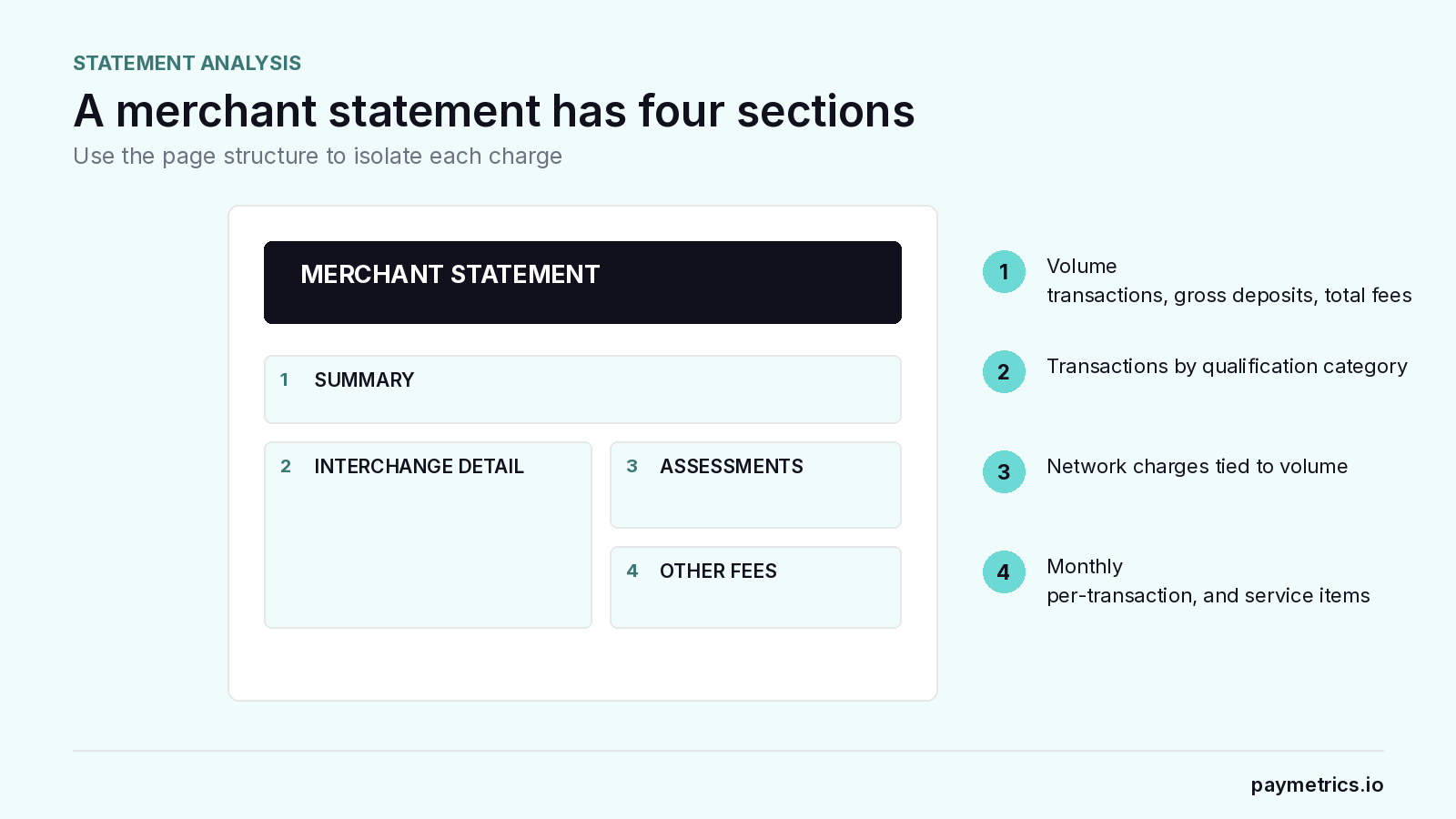
Markup hides in the fourth section far more often than the second. Interchange itself is fixed, as explained in what are interchange fees.
How Do You Calculate Your Effective Rate?
Divide total fees by total card volume, then multiply by 100. That single percentage is the only number that survives comparison across processors.
What Effective Rate Should You Expect?
Effective rates commonly land between 2.5% and 3.5% for card-present retail and higher for card-not-present volume. A rate above that band signals downgrades, padded markup, or an unsuitable pricing model rather than expensive customers.
What Are the 7 Steps of a Line-by-Line Review?
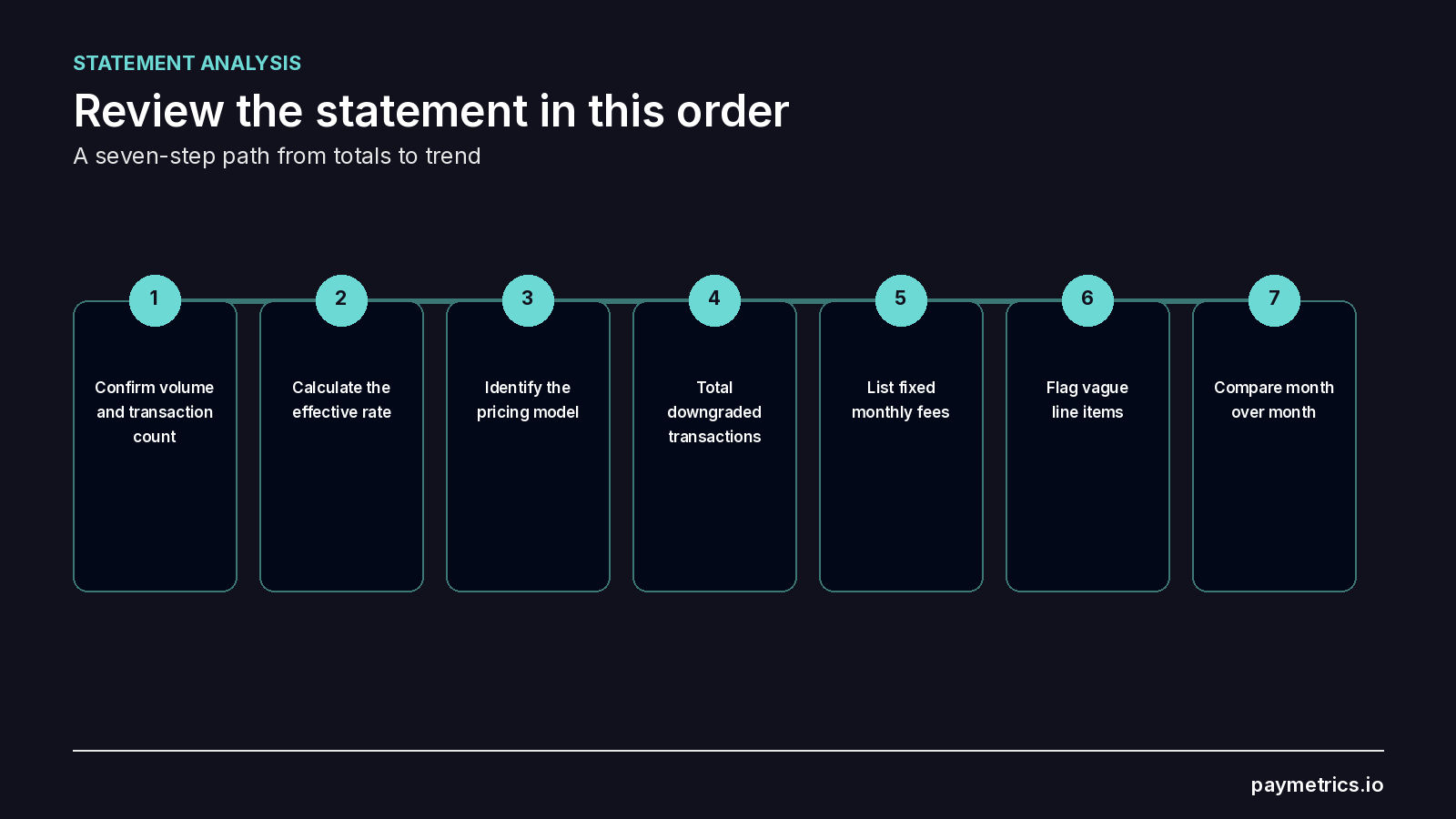
Work the statement in this order.
- Confirm total volume and transaction count against your own records.
- Calculate the effective rate before reading any individual line.
- Identify the pricing model as interchange plus, tiered, or flat rate.
- Total the downgraded transactions and the categories they fell into.
- List every fixed monthly fee and match it to a service you use.
- Flag any line item with a vague label or no stated basis.
- Compare month over month to catch rates that drifted upward.
Which Line Items Deserve the Most Scrutiny?
Four line items generate the most recoverable cost.
- PCI non-compliance fees charged while your certification is current.
- Statement, batch, and gateway fees billed in duplicate across systems.
- Downgrade or non-qualified surcharges on tiered pricing plans.
- Annual or quarterly fees that appear without notice.
Merchants on tiered pricing see the largest gaps, and the fix is usually structural. Our guide to how to reduce credit card processing fees walks through 7 tactics that address the causes rather than the symptoms.
How Do You Spot a Padded Statement?
A padded statement uses vague labels and bundled categories that prevent line-by-line verification. Five signals appear consistently.
- Fee descriptions with no stated calculation basis or rate.
- Bundled service charges that combine unrelated items into one figure.
- Non-qualified volume exceeding 20% of total transactions.
- Fees for services the merchant does not use, such as unused gateway licenses.
- Rate changes applied without the advance notice your agreement requires.
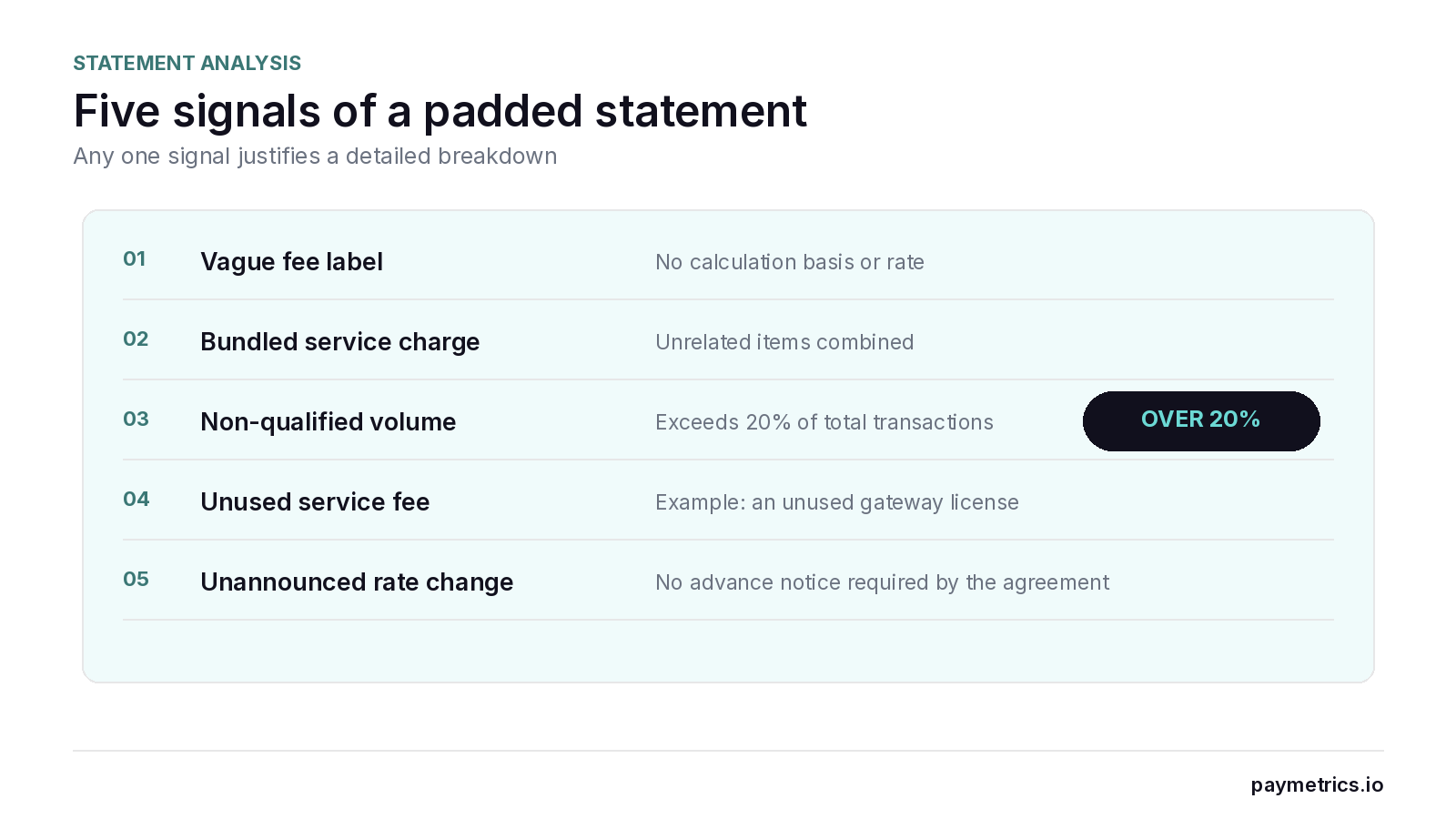
Any one signal justifies a request for a detailed breakdown from your provider. Providers who cannot itemize a charge on request are the providers most likely to be adding one.
Turning the Analysis Into Savings
An analysis only pays for itself when it changes something. Renegotiating markup, correcting merchant category codes, and fixing batch timing all move the effective rate within one billing cycle.
Merchants who want a second set of eyes can send a recent statement through our contact page for a no-cost review. Bring 3 months of statements and a rough breakdown of card-present versus card-not-present volume, since the mix determines which corrections carry the most value.
Frequently Asked Questions
How many months of statements should you analyze?
Review 3 consecutive months. A single statement hides seasonal volume swings and one-time fees, while 3 months reveals the pattern and any rate that crept upward quietly.
What is the difference between tiered and interchange plus pricing?
Tiered pricing sorts transactions into qualified, mid-qualified, and non-qualified buckets set by the processor. Interchange plus passes through the actual interchange cost and states the markup separately, which makes the statement readable.
Who should perform the analysis?
Any operator who can pull 3 months of statements can run the calculation. An outside review helps when the statement uses bundled labels, since a provider reviewing its own pricing has no incentive to flag padded lines.
Does a lower quoted rate mean lower total cost?
No. Quoted rates apply only to qualifying transactions. Total cost depends on the effective rate across all volume, which is why the calculation comes before any comparison.
Table of Contents
Subscribe to our newsletter
Get the latest insights and updates delivered to your inbox.
What Is a Payment Facilitator (PayFac)?
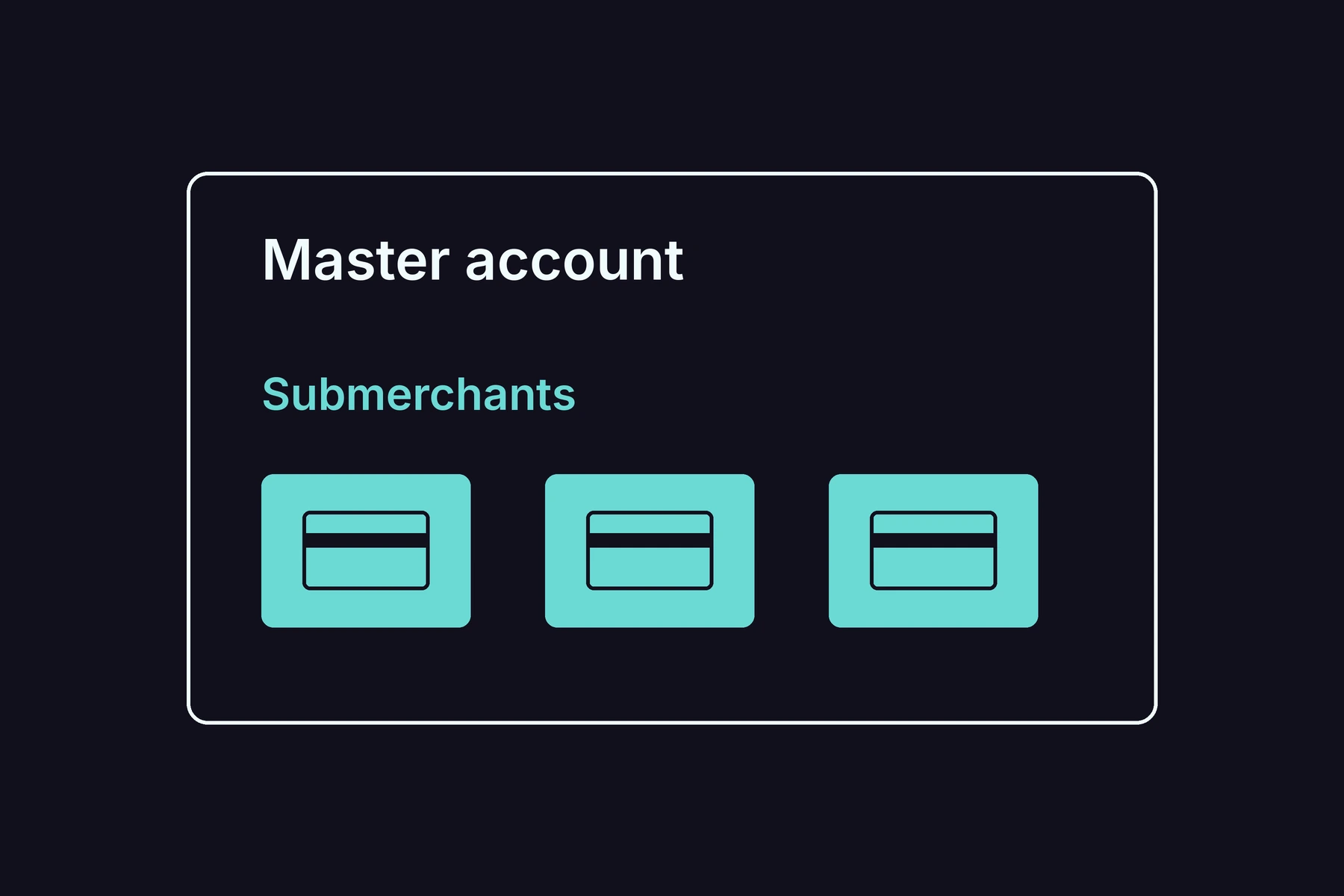
A payment facilitator, commonly shortened to PayFac, is a company that holds a master merchant account and onboards other businesses as submerchants underneath it.

How to Calculate Credit Card Processing Fees: The 3-Step Method We Use on Every Statement Audit
Calculate your effective processing rate in three steps, compare healthy ranges, and find hidden costs on merchant statements.
What Is 3D Secure and Should You Enable It?
3D Secure is an authentication protocol that verifies a cardholder’s identity during online checkout before the transaction is authorized.